













BetOnRed payment methods for deposits and withdrawals
The Polish cashier offers more channels for receiving money than for sending it back to a player, and the route used to put money into an account affects the available routes for withdrawing it.
Assess both directions before relying on a particular service. The lists below count four different things separately: payment channels and services, banking institutions, fiat currencies and crypto assets. Adding those counts would produce a misleading total of payment methods. A bank, payment network and denomination are distinct elements of a transaction and are not interchangeable.
Deposit channels and services
The deposit roster combines conventional instruments such as Visa and Mastercard with local bank payment options, wallets and digital asset services; BLIK appears in several distinct forms, including contactless payment and transfer to a phone number.
| Category | Count | Roster entries |
|---|---|---|
| Payment channels and services | 35 | BLIK, BLIK Contactless, BLIK Transfer to Phone, Bank Transfer, Instant Bank Transfer, Pay-by-Link, SEPA Credit Transfer, SEPA Instant Credit Transfer, SWIFT, Elixir, Express Elixir, Visa, Mastercard, American Express, Apple Pay, Google Pay (Google Wallet), Samsung Wallet (Samsung Pay), PayPal, Skrill, NETELLER, paysafecard, Revolut Pay, Wise, Paysera, ZEN.COM, PayU, Przelewy24, Tpay, Autopay, paynow, Klarna, Stripe, Adyen, Kraken, Coinbase |
| Banks and banking institutions | 32 | National Bank of Poland (NBP), PKO Bank Polski, Bank Pekao, mBank, ING Bank Śląski, Bank Millennium, Alior Bank, BNP Paribas Bank Polska, Credit Agricole Bank Polska, VeloBank, Citi Handlowy, Bank Pocztowy, Bank Gospodarstwa Krajowego (BGK), Bank BPS, SGB-Bank, Nest Bank, Santander Consumer Bank, Deutsche Bank Polska, UniCredit, Revolut Bank, N26, bunq, Inbank, Bank of China, Industrial and Commercial Bank of China (ICBC), HSBC Continental Europe, Danske Bank, Intesa Sanpaolo, SEB, Standard Chartered, Trade Republic Bank, U.S. Bank Europe |
| Fiat currencies | 22 | Polish Zloty (PLN), US Dollar (USD), Euro (EUR), British Pound (GBP), Swiss Franc (CHF), Czech Koruna (CZK), Danish Krone (DKK), Norwegian Krone (NOK), Swedish Krona (SEK), Hungarian Forint (HUF), Romanian Leu (RON), Turkish Lira (TRY), Japanese Yen (JPY), Chinese Yuan (CNY), Singapore Dollar (SGD), Australian Dollar (AUD), Canadian Dollar (CAD), UAE Dirham (AED), Saudi Riyal (SAR), Indian Rupee (INR), Mexican Peso (MXN), Brazilian Real (BRL) |
| Crypto assets | 15 | Bitcoin (BTC), Ethereum (ETH), Tether (USDT), USD Coin (USDC), EURC (EURC), BNB (BNB), Solana (SOL), XRP (XRP), TRON (TRX), Litecoin (LTC), Bitcoin Cash (BCH), Dogecoin (DOGE), Cardano (ADA), Stellar (XLM), Toncoin (TON) |
For comparison, a regular BLIK payment uses a six-digit code and requires confirmation in the banking app when the route is available. A Pay-by-Link or bank transfer request uses its own payment process. The experience depends on the instrument as well as the cashier: a bank may restrict a payment even when the corresponding service appears in a list.
Withdrawal routes and card eligibility
The narrower Polish payout list includes regular BLIK but not the separate contactless and phone-transfer variants. The same distinction is visible in the card and wallet categories: some instruments are listed only on the funding side of the cashier.
| Category | Count | Roster entries |
|---|---|---|
| Payment channels and services | 16 | BLIK, Bank Transfer, Instant Bank Transfer, Pay-by-Link, SEPA Instant Credit Transfer, SWIFT, Visa, Mastercard, Apple Pay, Google Pay (Google Wallet), PayPal, paysafecard, Revolut Pay, PayU, Przelewy24, Stripe |
| Banks and banking institutions | 16 | National Bank of Poland (NBP), PKO Bank Polski, Bank Pekao, mBank, ING Bank Śląski, Bank Millennium, Alior Bank, BNP Paribas Bank Polska, Credit Agricole Bank Polska, VeloBank, Citi Handlowy, Revolut Bank, N26, bunq, HSBC Continental Europe, Trade Republic Bank |
| Fiat currencies | 12 | Polish Zloty (PLN), US Dollar (USD), Euro (EUR), British Pound (GBP), Swiss Franc (CHF), Czech Koruna (CZK), Norwegian Krone (NOK), Swedish Krona (SEK), Romanian Leu (RON), Turkish Lira (TRY), Australian Dollar (AUD), Mexican Peso (MXN) |
| Crypto assets | 8 | Bitcoin (BTC), Ethereum (ETH), Tether (USDT), USD Coin (USDC), BNB (BNB), Solana (SOL), XRP (XRP), TRON (TRX) |
An instrument's presence on the withdrawal list is not a promise that a particular bank card will receive money. In its payout conditions, the operator specifies Visa Original Credit Transfer (OCT) and Mastercard Payment Transfer. The card issuer must support the relevant transaction; even a supported payment scheme may encounter an issuer's refusal.
Among the BetOnRed cashier options, cards and bank rails overlap with several e-wallet and local payment options across the two directions. Under the same-method rule in §1.6, withdrawals must use the same payment method as the deposit.
That makes the payout-side capability of your original payment instrument particularly important.
Banks, fiat currencies and crypto assets
The Polish list of banking institutions includes domestic and international names, but it does not establish that each institution offers every payment channel or account type. Likewise, the separate fiat list means that 22 denominations are represented on deposit and 12 on withdrawal; the displayed balance and the available settlement choices depend on the account and selected instrument.
The crypto lists name assets rather than all their supported blockchain networks. Tether, for instance, can be transferred through different networks. The Polish USDT deposit minimum applies specifically to TRC20; the payout network must be read from the relevant withdrawal card. Even two entries with the same asset name do not establish an identical network in both directions.
Which currency and limit apply to your account
Use the threshold shown for the selected route in the currency of that transaction rather than simply converting a generic EUR figure into PLN, since the payment processor may set a separate minimum.
Account display and settlement currency
In the PLN profile, I saw PLN, USD, EUR, GBP, CZK, NOK and cryptocurrency among the account display options. These are not the same thing as the complete deposit and withdrawal fiat rosters. Section 2.9 specifies EUR as the internal operating currency; conversion by the bank or payment processing provider may create differences between the amount requested and the amount actually debited.
For a Polish reader with a PLN-denominated bank account, avoiding an unnecessary currency mismatch can simplify the interpretation of a payment. The relevant comparison is the amount leaving the payment instrument against the final credit or receipt, including any commission and foreign exchange adjustment.
Minimum deposits by payment route
The listed minimums in Poland range from the equivalent of 25 PLN for USDT on TRC20 to 50 PLN for MiFinity, whose separately established threshold does not add another entry to the 35-channel roster.
| Method | Payment type | Minimum deposit |
|---|---|---|
| Visa | Card | 45 PLN |
| Mastercard | Card | 45 PLN |
| Tether (USDT) | TRC20 crypto transfer | 25 PLN equivalent |
| Bitcoin (BTC) | Crypto transfer | 40 PLN |
| MiFinity | E-wallet | 50 PLN |
The cashier minimum is different from the eligibility amount for a promotion.
The casino's Polish welcome offer requires a credit of at least 80 PLN through an eligible payment method. That threshold is 35 PLN higher than the card minimum. A separate qualifying deposit of 80 PLN activated a bonus of 80 PLN and 150 free spins; the cash-only card experiment discussed below was not that bonus transaction.
General deposit terms (§§6.2 and 6.10) refer to amounts of €2, €5, €10 or €15, depending on country. The operator FAQ separately describes a typical €20 minimum, depending on method. Neither set of figures replaces the Polish method-specific values in the table. See the separate deposit conditions and minimums for details of the funding process.
Withdrawal limits and account controls
The general minimum withdrawal is €50 or equivalent unless the specific method sets another condition. In the PLN card case, the calculation used 4.4089 PLN per euro, giving a threshold of 220.45 PLN. The selected card route used a 500 PLN withdrawal ceiling, with account limits of 1,500 PLN per day, 4,000 PLN per week and 10,000 PLN per month. Those ceilings describe one account and one payment path, not a site-wide PLN tariff.
Maximum withdrawal amounts can vary by payment method, account limits and loyalty rank. Under §2.1, a withdrawal that exceeds the payment system's limit is paid in instalments. A further contractual constraint under §2.13 concerns winnings above €10,000 or $10,000: the operator may pay in monthly instalments of up to €10,000 or $10,000 respectively.
You can also set personal deposit limits for daily, weekly or monthly spending in the account controls. Raising or removing a limit takes 24 hours under the deposit-limit conditions, while a zero limit blocks the account for six months. The permitted payment amount must respect the applicable controls; the availability of a payment service does not override them.
What the card and crypto transactions cost
The PLN Visa route delivered the full requested amount in both directions in my tests, while the separate USDT case incurred a sender-side network fee. Comparing actual receipts, elapsed times and individual charges makes the difference clearer than looking only at the amount entered on the payment form.
| Operation | Amount sent or requested | Credited or received | Charge | Elapsed time |
|---|---|---|---|---|
| Visa deposit | 80 PLN | 80 PLN | 0 PLN | 28 seconds |
| Visa OCT withdrawal | 250 PLN | 250 PLN | 0 PLN | 38 minutes |
| USDT/TRC20 deposit | 35 USDT | 133.00 PLN | 0.8 USDT network fee in addition; operator 0 USDT | 2 min 16 sec |
The PLN card test, from funding to payout
I tested an 80 PLN Visa debit-card deposit with no bonus applied. The method capped the payment at 1,000 PLN, and I had 1,000 PLN left under my personal deposit limit. The lower of the two limits applied. The form was valid for 15 minutes from creation, and I authorised the payment through the issuer's 3-D Secure check. The full 80 PLN reached the casino balance 28 seconds after I sent the deposit. The card debit and the casino credit matched.
All three potential charging parties, the operator, the issuer and the intermediary, recorded a zero charge in the same-currency path; with a foreign-currency card or another payment provider, the arithmetic can differ even when the amount on the casino form is identical.
The cash balance and the amount eligible for withdrawal must also be distinguished. In the same experiment, recorded stakes totalled 246 PLN and gross game returns totalled 482 PLN. The original 80 PLN funding amount, less the stakes and plus gross returns, left 316 PLN in the balance before the withdrawal request.
These numbers explain the payment ledger, not an expected gaming result.
The ordinary-deposit turnover rule in §2.6 required 240 PLN of qualifying turnover (3 × 80 PLN), which the 246 PLN total satisfied in this non-bonus case; no bonus balance or free-spin return was combined with that calculation. For an account with an active promotion, both the promotion conditions and the cash balance have to be considered separately.
I requested 250 PLN back to the same Visa card. The request first reserved the amount, leaving 66 PLN outside the reservation, below the 220.45 PLN minimum in that example. Confirmation came after 22 minutes, release four minutes later and receipt after a further 12 minutes. The total time from request to receipt was therefore 38 minutes. The card received 250 PLN without a deduction; the confirmation and recipient-credit times were different milestones.
I observed a range of 10–35 minutes for withdrawal confirmation. That range describes the approval stage, not the time until money reaches your bank. For further context, BetOnRed's payout conditions (§2.10) allow up to 72 hours of processing before release, followed by the payment method's own delivery time. The FAQ separately describes processing typically within 24 business hours following approval.
The USDT route and the cost of sending crypto
The separate TRC20 transaction, on a route capped at the equivalent of 1,000 PLN per request in that case, shows why a network fee cannot be evaluated in isolation from the amount credited.
A transfer of 35 USDT at a quoted rate of 3.80 PLN per USDT produced a balance credit of 133.00 PLN. The network charged 0.8 USDT above the amount transferred, making the total wallet debit 35.8 USDT, without reducing the 35 USDT sent. At that quote, the sender-side network fee corresponds to 3.04 PLN, roughly 2.29% of the transfer amount. This is a calculation for that transaction, not a standing TRC20 tariff.
A small fixed fee is proportionately more significant in a small transfer, and the total economic cost also depends on the original cost of acquiring the token.
The payment was credited after 19 network confirmations, with a total elapsed time of 2 minutes and 16 seconds: a fast credit in that particular network transaction, not a guaranteed confirmation count or deadline for every transfer.
The possible cost of selecting an incorrect network is much greater than a routine network charge. Under §2.8 the operator may consider recovering a wrongly sent crypto sum only above €5,000, subject to a 0.1 BTC recovery fee, and does not guarantee recovery. Consult the crypto payment and network conditions for the implications of the specific asset and network.
Bank transfers, local instant payments and fees
Bank payments use their own clearing and processing rules. The deposit FAQ indicates that a bank transfer typically takes up to 24 business hours but can take up to five business days; electronic transfers typically take up to 24 hours, or up to two business days in rarer cases. These general descriptions do not set a timeframe for every Polish bank or instant payment service. For withdrawals by bank transfer, §2.16 allows intermediary banks to charge up to the equivalent of €16 in exceptional cases.
That provision concerns intermediary charges; separate conversion costs can arise where the payment account, requested currency and actual settlement currency differ, so the final fee is specific to the transaction rather than the icon on the dashboard.
This is why the card, bank/instant and crypto routes are not directly interchangeable. Card payments are dependent on the issuer and its authorisation checks; bank rails may include intermediary handling; and crypto involves network confirmation and an address/network match in addition to the operator's own processing. The right financial comparison is of the actual amount received and the complete elapsed time.
Checking a payment method before you submit a transaction
If you already have an eligible account, the operator's cashier is where you can assess the available directions, currencies and costs; the country of the gaming profile, payment account, instrument type and issuer may each affect which of the Polish roster entries appears for you.
- Open the cashier from the authenticated lobby and choose the Deposit or Withdrawal tab according to the intended transaction.
- Check a route's displayed currency, the method-specific minimum and any maximum; compare the displayed fee with the bank or wallet's own charge.
- Verify that the payment account is yours and that the name matches your gaming profile. For withdrawals, inspect whether your original deposit method supports receiving funds.
- For a crypto route, compare the asset and network shown on the payment card with those supported by your wallet. Do not act on an asset name alone.
- Check for an account limit, unfinished verification or active bonus condition before making a financial commitment. Do not proceed where the transaction is restricted.
I checked the cashier and account interface on a Tecno Camon 50 Pro 5G running Android 16 and an Apple iPhone 18 Pro running iOS 27. In the desktop browser, opening the cashier and selecting Deposit took two interactions from the authorised lobby. In a separate cross-device check, refreshing the second session showed the same 80 PLN balance and card deposit history, reflecting the server-side account record rather than a device-specific wallet.
Payment ownership and withdrawal checks
The operator can request evidence of payment ownership, identity, address or source of funds. Even a depositing method that has worked before may require additional checks if circumstances change. Under §2.15, the operator processes withdrawals only after completing the required verification. The FAQ describes manual document review as taking up to 24 hours. In my first Visa withdrawal, the operator checked my identity and proof of address. A separate SMS confirmed the withdrawal request before its status changed to Confirmed.
The review took 17 minutes in a separate confirmed verification episode.
A new method may trigger re-verification even if the original method was accepted.
The anti-money laundering policy requires checks and director approval before processing a card withdrawal or bank transfer above €3,000 in a single transaction (§2.6). It also sets a maximum of three withdrawals and €9,000 in total per day. Enhanced due diligence is required above €3,000 in 24 hours or €9,000 over 90 days (§2.7). These are policy thresholds independently of what the Polish cashier permits for a particular payment.
Further, the payout conditions require active deposits to be turned over at least three times. If an active bonus blocks payout, the FAQ requires completion or cancellation of the blocking promotion. This does not mean that cancellation converts every bonus-related balance into withdrawable cash. For the verification conditions and protection of funds, see account verification and licence and safety.
A delayed or declined transaction
Check the operator's transaction records before treating a payment as unsuccessful. A deposit may stay pending because the provider has not completed its handling; a withdrawal approved by the operator may still be awaiting delivery. Analyse the current status and financial receipt rather than just the time since submission.
- Open Profile and then Transactions History. Select the Deposits or Withdrawals category rather than searching game or other history.
- Find the transaction, compare its currency and amount with the corresponding bank statement or wallet record, and note its status.
- If it is pending, do not duplicate the request. If you encounter a decline, check the displayed cause, including issuer authorisation, account limits and any missing verification.
- Contact the operator's support through the account's help route if you need reconciliation, and share only the relevant details securely.
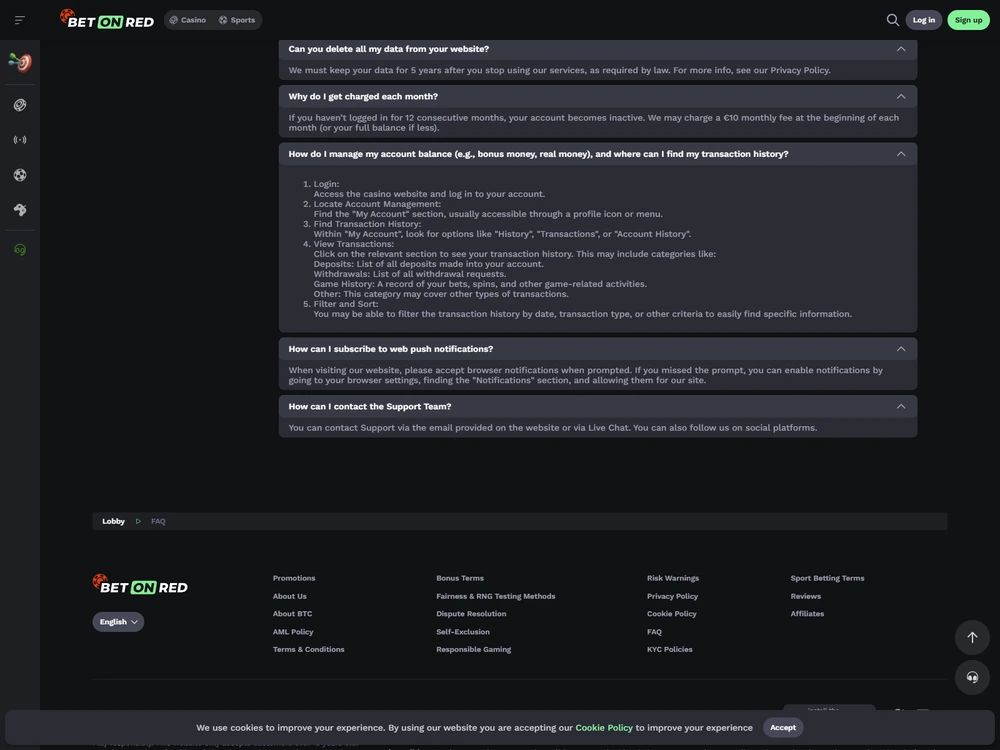
The cash ledger also determines whether a correction is necessary. The account rules provide for recovery of incorrectly credited amounts, and §2.3 generally excludes refunds or cancellations of transactions. Transfers between players are not permitted under §1.8; the account is not a currency exchange service under §2.17. BetOnRed Opinie is a separate editorial site and does not process, verify or resolve player payments itself.
BetOnRed is permitted to operate in Poland. Account eligibility still applies to registrations and payments.
In the PL/PLN configuration, the lobby was visible while registration was closed.
Why payment listings differ between markets
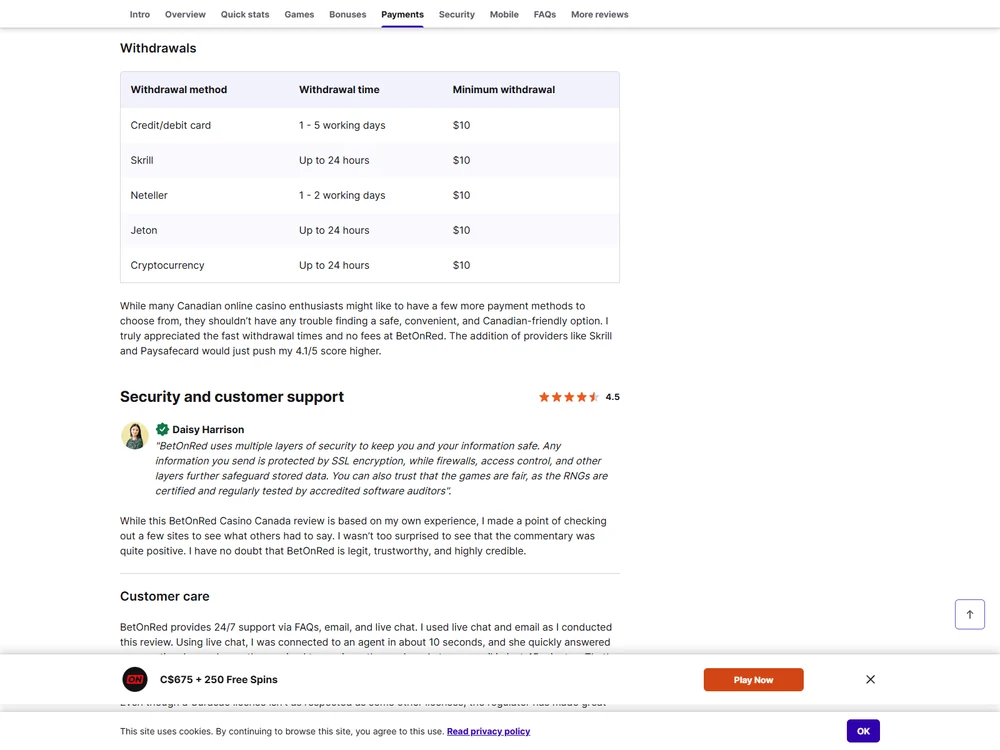
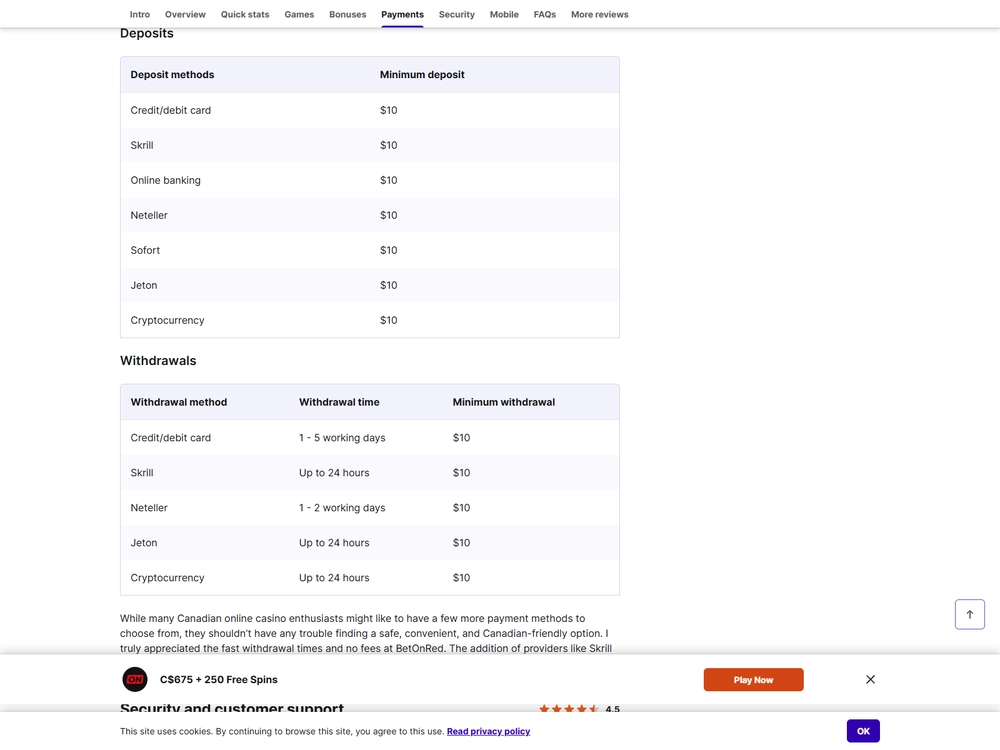
Different publications describe different cashiers and operating conditions. AskGamblers lists BLIK as a deposit method, while the Polish roster includes it in both directions. Its structured EUR/USD withdrawal limits are 2,000 per day, 5,000 per week and 15,000 per month, with 0–24 hours pending time. A separate article names €5 and €50 as funding and payout minimums and up to 72 hours for processing. Those figures describe distinct contexts, not a replacement for the PLN limits.
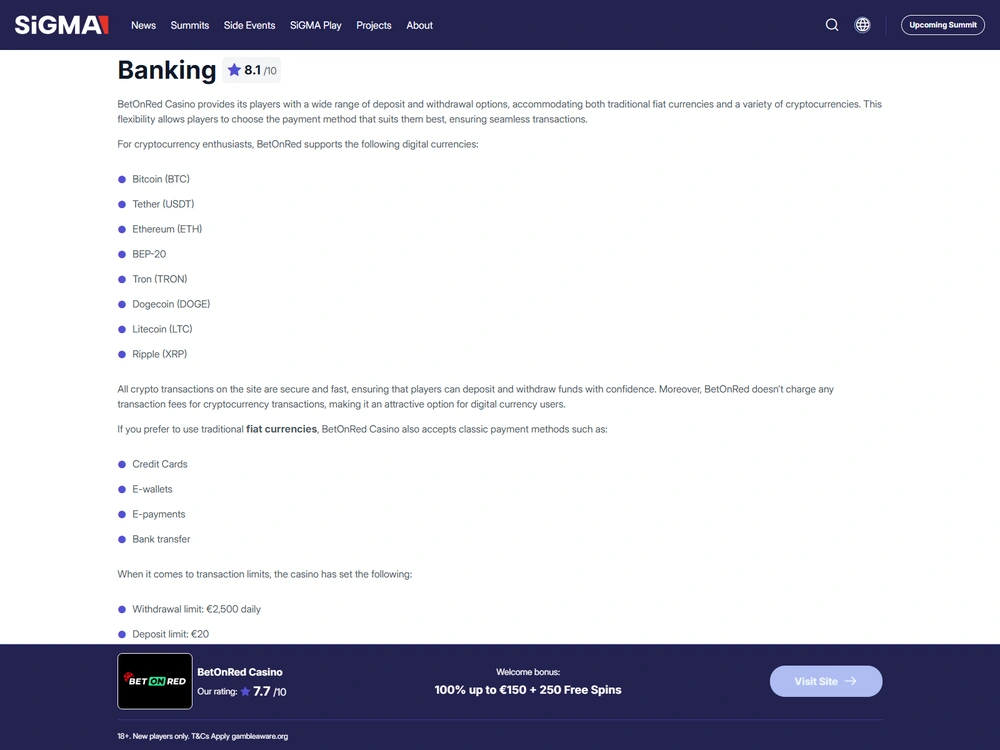
Casino.org's Canadian payment table uses $10 minima for the listed routes and a card withdrawal delivery range of one to five business days. SiGMA lists 19 payment icons without separating directions, a €2,500 daily payout limit, a one-to-five-day payout range and a €20 deposit field.
Readers in Poland should distinguish those published conditions from their selected Polish payment route.
Payment method comparison and verdict
BetOnRed payment methods score 6.4/10 for the Polish account context. The broad funding roster, lower confirmed route-specific minima and quick, fee-free same-currency card transactions are useful strengths. The measured USDT network fee, narrower payout roster, withdrawal limits, turnover, verification and route or country eligibility constraints limit the score.
| Criterion | Weight | Score out of 10 |
|---|---|---|
| Payment-method breadth | 15% | 8.0 |
| Deposit accessibility and limits | 10% | 7.0 |
| Withdrawal accessibility and limits | 15% | 5.0 |
| Actual processing speed | 20% | 7.0 |
| Fees | 10% | 7.0 |
| KYC and withdrawal friction | 10% | 5.0 |
| GEO availability | 10% | 5.0 |
| Terms and limit transparency | 10% | 6.0 |
| Overall | 100% | 6.4 |
One useful counterpoint to the successful Visa payout is a Polish complaint published by AskGamblers. The player reported four deposits totalling 4,500 PLN, one completed withdrawal of 590 PLN, ten subsequent cancellations and requests for additional verification documents. The platform marked the 4,241 PLN complaint resolved. The reported experience is a reason to distinguish a successful test from a guarantee of future approval.
The best basis for comparing methods is the combined set of limits, fees and restrictions for both directions, not deposit convenience alone. For the detailed conditions governing receipt of funds, consult the withdrawal limits and processing times; the scoring approach is explained in the Methodology.
FAQ
What are the minimum deposits by payment method in Poland?
Card funding starts at 45 PLN for Visa and Mastercard in the Polish profile. The USDT/TRC20 minimum is equivalent to 25 PLN; Bitcoin requires 40 PLN and the MiFinity threshold is 50 PLN. The separate welcome offer requires a credit of at least 80 PLN through an eligible payment method.
Do BLIK and Pay-by-Link appear in both Polish payment rosters?
Yes. Both appear on the Polish deposit and withdrawal lists, alongside Bank Transfer and Instant Bank Transfer. Individual account eligibility, method support and issuer restrictions still determine the available routes for an actual transaction.
Can a withdrawal use an instrument other than the deposit method?
The general rule in §1.6 requires withdrawals to the method used for depositing. You must also meet payment ownership and verification conditions. Visa OCT and Mastercard Payment Transfer depend on issuer support.
Are all transactions free of charge?
No. The tested same-currency Visa transactions had zero fees, but the tested USDT transfer incurred a 0.8 USDT network charge above the amount sent. Foreign currency conversion can add costs. Intermediary banks may charge for withdrawals by bank transfer in exceptional cases.
How long does a payment take?
My Visa deposit credited in 28 seconds, and the Visa withdrawal reached the card in 38 minutes. Actual timing depends on the method and approval. The payout terms allow up to 72 hours for processing before separate delivery by the payment provider.
What does PLN in the account display mean?
PLN is the displayed denomination of the Polish balance in the checked profile. The site's internal operating currency is EUR. A different payment-account currency can lead to conversion and differences between the requested and debited amounts.
Why might a payment be restricted?
Issuer limits, country eligibility, account limits, unfinished identity verification and blocking promotion conditions can restrict payments. The specific withdrawal method must support the requested direction as well as match the conditions governing the original deposit.
Where can you see pending transactions?
Open Profile, then Transactions History. Choose the Deposits or Withdrawals category and inspect the amount and status. Compare it with the corresponding provider record before making any further request.