
Which assets do BetOnRed crypto payments support?
In Poland, the cashier lists Bitcoin, Tether, Ethereum and other crypto assets separately for deposits and withdrawals. The two lists are not interchangeable: they have eight assets in common, while the deposit list includes seven additional assets. That difference matters if you are considering how funds would eventually leave the account.
| Asset | Polish deposit roster | Polish withdrawal roster |
|---|---|---|
| Bitcoin (BTC) | Listed | Listed |
| Ethereum (ETH) | Listed | Listed |
| Tether (USDT) | Listed | Listed |
| USD Coin (USDC) | Listed | Listed |
| EURC | Listed | Deposit roster only |
| BNB | Listed | Listed |
| Solana (SOL) | Listed | Listed |
| XRP | Listed | Listed |
| TRON (TRX) | Listed | Listed |
| Litecoin (LTC) | Listed | Deposit roster only |
| Bitcoin Cash (BCH) | Listed | Deposit roster only |
| Dogecoin (DOGE) | Listed | Deposit roster only |
| Cardano (ADA) | Listed | Deposit roster only |
| Stellar (XLM) | Listed | Deposit roster only |
| Toncoin (TON) | Listed | Deposit roster only |
The asset table is a useful starting point for comparing BetOnRed cryptocurrency methods, but it is the direction selected, the account configuration and the method card that determine the relevant asset-and-network combination. The wider Polish cashier also lists Kraken and Coinbase among payment services for deposits; count such services separately from the assets.
For a Polish reader, three different units may be relevant in a single operation. Your balance can be displayed in PLN, the wallet transfers a crypto asset such as USDT, and the operator's internal accounting currency is EUR. The Polish profile also displays USD, EUR, GBP, CZK and NOK. Displaying zlotys does not validate legal access in Poland or guarantee a particular route.
The 25 PLN equivalent threshold belongs specifically to the USDT TRC20 deposit; the 40 PLN threshold belongs to Bitcoin deposits. For the broader selection of fiat instruments, banks and payment services, see the separate payment methods page.
Networks and wallet checks before a deposit
The essential condition for a crypto transfer is a match between the asset and its network on both sides. For example, USDT on TRON uses the TRC20 route. USDT on ERC20 remains the same asset but travels via a different network. A USDT address for one route should not be treated as interchangeable with an address for the other.
How to read the crypto deposit form
The Crypto option opens a form for the specific asset, network and direction. The interface includes network examples such as ERC20, TRC20 and BEP20. These examples are not promises of availability in a particular Polish account. Look at the choices on the method card itself: the form calculates the amount and quote for the selected route before the next step.
When the operator's cashier is available to you and you meet the applicable eligibility requirements, use this checklist to interpret the form before authorising any payment:
- Open Deposit, choose Crypto and select the required crypto asset. Check the available network choices separately from the name of the asset.
- Read the minimum, upper limit, amount and quoted equivalent on that particular card. Compare the credited amount with any bonus qualification threshold rather than assuming the deposit minimum is also the bonus minimum.
- Select Continue to inspect the generated address or QR code. Compare the asset and network indicated on the deposit card against the corresponding settings in your wallet.
- Check whether the form requires a separate memo or destination tag. The tested TRC20 route used an address without a memo; a separate tag shown for another route must also match.
- Check the wallet's total cost before confirmation, including any external network fee expressed separately from the amount being transferred.
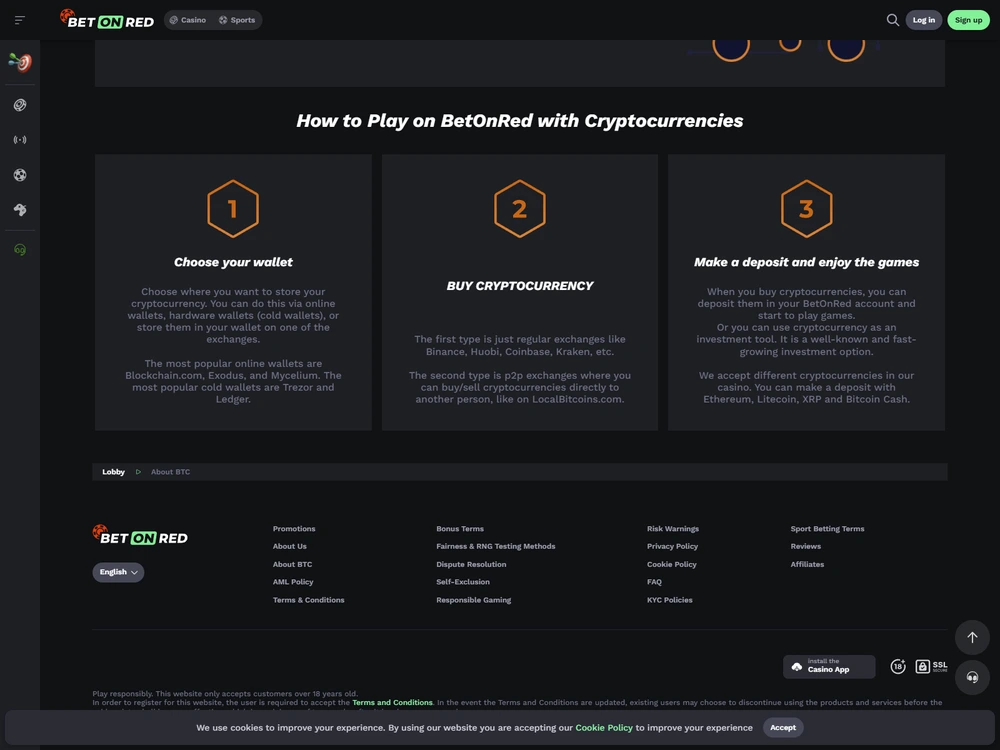
A wallet may be software-based, stored on hardware or hosted by an exchange. Its purpose in a casino payment is the same regardless of where it is hosted: to send or receive the relevant asset using the network supported by that operation.
Support for a token by name does not necessarily mean that the wallet supports every network on which that token can circulate.
The operator's instructions distinguish blockchain confirmation from the amount shown on the balance. Once a transfer is submitted, it can still be pending in the cashier until the required confirmations have been recorded. The window can be closed after sending. Follow the remaining stages in the original transaction history rather than opening a new deposit card.
The operator can request identity verification when you deposit. If your own gambling limit has been reached, an otherwise eligible amount may still fail the payment checks. The separate deposits page explains the general cashier limits and procedures.
What the USDT TRC20 payment actually costs
In my Polish USDT TRC20 deposit test, the total wallet cost was 35.8 USDT to send 35 USDT. I paid the extra 0.8 USDT to cover the network fee, so the transferred amount remained intact. The address was created for the selected TRC20 deposit. The cashier showed a minimum of 25 PLN equivalent and a working maximum of 1,000 PLN equivalent for that particular request.
Amount sent versus amount credited
In this test I sent 35 USDT and the cashier credited 133.00 PLN at the 3.80 PLN per USDT rate shown on the payment card (35 × 3.80). The operator's fee was 0 USDT, and the wallet's total expenditure was 35.8 USDT. This illustrates why a zero operator fee does not necessarily mean a cost-free payment.
| Metric or stage | Value in the example | Meaning |
|---|---|---|
| Minimum | 25 PLN equivalent | Lower threshold of this deposit route |
| Maximum | 1,000 PLN equivalent | Upper threshold for this particular request |
| Transfer | 35 USDT | Amount sent to the generated address |
| Operator fee | 0 USDT | No deduction by the cashier |
| Network fee | 0.8 USDT | Additional wallet cost |
| Total wallet expenditure | 35.8 USDT | Transferred amount plus network fee |
| Quote | 3.80 PLN per USDT | Rate used to calculate the credit |
| Cashier credit | 133.00 PLN | Amount added to the balance |
| 19th confirmation | 2 min 6 sec | Elapsed from submission |
| Credited status | 2 min 16 sec | Balance updated 10 seconds later |
Expressing the network fee in zlotys at this quote gives 3.04 PLN, or about 2.29% of the 35 USDT transferred. The cost was a fixed 0.8 USDT in this particular operation rather than a proportional charge. These equivalents illustrate the wallet expense; they are not further deductions from the credited balance. Network fees can differ. The deposit form warns that the exchange rate can vary and the final amount may differ slightly. If the quote expires, use the new card's quote for the calculation instead of assuming the same exchange rate.
Confirmation time and comparison of costs
I observed the 19th network confirmation after 2 minutes 6 seconds. The cashier then changed to credited status 10 seconds later. The full send-to-credit interval was 2 minutes 16 seconds. These are two distinct stages of one completed deposit, not separate measures of the operator's cryptocurrency withdrawal time.
In comparable USDT TRC20 scenarios expressed in PLN equivalents, Gamdom had a 25 PLN deposit minimum, a 3 PLN equivalent external fee and a 3-minute 6-second send-to-credit interval. Cloudbet's corresponding figures were 35 PLN, 4 PLN and 3 minutes 22 seconds. These results describe individual routes and transactions; they do not establish a permanent ranking or guarantee availability to residents of Poland.
The first PLN casino welcome stage has a credited-amount threshold of 80 PLN. The 133 PLN balance credit from the test exceeds it by 53 PLN. That only deals with the amount criterion. Eligibility for the offer also depends on the method, and the separate deposit minimum is not a substitute for promotional qualification.
Crypto withdrawals and payment limits
Crypto withdrawals depend on the selected withdrawal method and its own network. The presence of USDT in both Polish lists does not make the TRC20 deposit route automatically valid for a withdrawal.
The receiving wallet must match what is shown on the withdrawal card itself.
Verification and eligibility
The operator's terms require withdrawal via the same method used to deposit. Section 2.6 also sets a turnover requirement of at least three times active deposits. Consider these obligations separately from the minimum withdrawal amount. Account verification and active bonus conditions can prevent a withdrawal from progressing even if its amount falls within the method's limits.
Identification can be required for the first payout, and no cashouts are processed until the account is fully verified. Payment verification may involve information about the owner of an e-wallet, evidence of the deposit transaction or proof of the source of funds. Proof-of-funds examples include income documentation from the last 90 days.
The AML policy specifies enhanced due diligence for withdrawals exceeding €3,000 in 24 hours or €9,000 in 90 days. These are additional verification conditions, not limits promising availability of that amount. Ordinary verification can still apply to smaller payments. See the full explanation of account verification for the document categories and possible checks.
Before confirming any eligible crypto withdrawal, inspect the rules and fields for that direction:
- Check the verification status and whether the deposited funds meet the active-deposit turnover and relevant bonus requirements.
- Open Withdrawal and select the eligible payment method used for the originating deposit. Read the cryptocurrency and network requirements for the receiving wallet.
- Check the minimum, applicable per-request cap and any remaining daily, weekly or monthly allowance in the cashier. The maximum may depend on the method and loyalty rank.
- Compare the receiving address and any required tag or memo against the selected asset and network. Review the amount and any fee displayed before confirmation.
- Follow the request through Transactions History rather than treating a submitted request as a completed payout.
How the limits translate into USDT
In the Polish calculation example, the lower bound is 58.02 USDT and the per-request ceiling is 131.57 USDT. The ordinary minimum set out in the withdrawal terms is €50 or equivalent unless a different amount is specified for the payment method. Converting €50 at 4.4089 PLN per EUR and rounding up to the nearest grosz gives a threshold of 220.45 PLN. A second quote of 3.80 PLN per USDT can then be used to express that amount in the asset.
| Condition | Input | PLN equivalent | Amount in USDT |
|---|---|---|---|
| Standard minimum, absent a different method term | €50 | 220.45 PLN | 58.02 USDT |
| Per-request ceiling in this scenario | 500 PLN | 500.00 PLN | 131.57 USDT |
For the lower bound, 220.45 ÷ 3.80 is rounded up to 58.02 USDT so that the equivalent amount does not fall beneath the minimum. For the 500 PLN ceiling, rounding down to 131.57 USDT keeps the equivalent within the limit. The two rounding directions serve different purposes. This is a calculation using the stated rates for the example rather than a universal withdrawal interval or a completed crypto payout. Under the payout terms, a request that exceeds the payment system's limit is paid in instalments.
The processing time in the operator's payout terms can reach 72 hours before a withdrawal is released. The FAQ separately describes most withdrawals as processed within 24 business hours after approval. After release, the arrival time depends on the method. For general stages and the distinction between approval and receipt, see the withdrawals guide.
Wrong network, pending transactions and refunds
An incorrect sending network or destination address carries a risk of losing the funds, and the deposit form warns that transfers below its minimum cannot be processed or returned even when the blockchain transfer appears technically successful from the wallet's perspective.
Section 2.8 of the payout terms applies when a crypto deposit is sent to the wrong network, for example when BTC is sent to a BCH address. The operator does not attempt recovery unless the amount exceeds €5,000. If that threshold is exceeded, it specifies a recovery expense of 0.1 BTC, and even then it does not guarantee the recovery. A higher transaction amount is not protection against an incorrect destination.
Refunds and cancellations are also excluded under the general terms. Before taking further action on a pending deposit, check Transactions History and the wallet's transaction record. Compare the amount, destination details and confirmation status with the original request. Do not send a duplicate transfer while the first payment is pending.
If the status remains unresolved, contact the operator's support with the transaction reference and the details required for the check. Keep addresses, account details and transaction identifiers private when seeking help publicly. BetOnRed Opinie is the editorial publisher, not the payment operator, and does not handle deposits, payouts or verification. Read the licence and safety information for the broader risk context.
Crypto versus loyalty Coins
WP and DP are internal status points, while Coins belong to the loyalty reward system. These are not the network-transferred crypto assets listed in the cashier. The account rules prohibit transfers between players. They also state that the account earns no interest and does not provide currency conversion or exchange services.
What to check first
The crucial details of BetOnRed crypto payments are the direction-specific asset list, exact network and chosen method's limits. A quick credit in one TRC20 deposit does not shorten a payout's verification or release stages. For accounts meeting the applicable eligibility requirements, check both directions and the full transaction cost before deciding whether to use a method.
FAQ
Which deposit assets also appear in the Polish withdrawal list?
The Polish withdrawal roster contains BTC, ETH, USDT, USDC, BNB, SOL, XRP and TRX. EURC, LTC, BCH, DOGE, ADA, XLM and TON appear only in the Polish deposit roster.
Is TRC20 necessarily the network for a USDT withdrawal?
No. The Polish USDT deposit route uses TRC20, but the network for a withdrawal must match the details of its own withdrawal card and your receiving wallet.
What is the minimum crypto deposit in the Polish cashier?
The minimum for USDT TRC20 is the equivalent of 25 PLN. Bitcoin has a 40 PLN deposit threshold. Both are method-specific values, not a single cashier-wide minimum.
How long did the USDT payment take to credit?
The demonstrated deposit reached credited status in 2 minutes 16 seconds after submission, with 19 network confirmations. The required confirmation count and crediting time belong to that route and transaction.
How was the network fee paid in the USDT deposit test?
The sending wallet paid 0.8 USDT in network fees on top of the 35 USDT transfer. The operator charged no fee for this deposit.
Can a deposit sent on the wrong network be returned?
For a crypto deposit sent on the wrong network, the operator's terms provide for no recovery attempt unless the amount exceeds €5,000, and specify a 0.1 BTC expense for attempting recovery in such cases. Successful recovery is not guaranteed. The deposit form separately warns that sub-minimum payments cannot be processed or returned.
Does paying with cryptocurrency remove the need for KYC?
No. The operator can request an identity check when you deposit and may check payment ownership, transaction records or the source of funds. Withdrawal requires full account verification.
Are loyalty Coins the same as cryptocurrency?
No. Coins are internal loyalty rewards, not the BTC, ETH or other assets used for a blockchain payment.